
Complete Stock Market Trading Guide for Beginners in the UAE (2026)
Navigating the financial markets can feel overwhelming when you first start. However, building a portfolio or executing short-term equity trades does not rely on luck. Success comes from understanding market structure, economic fundamentals, and clear risk management strategies.
This comprehensive Stock Market Trading Guide for Beginners in the UAE breaks down how local exchanges like the Dubai Financial Market (DFM) and Abu Dhabi Securities Exchange (ADX) operate, how to trade international stocks, and how aspiring traders can build long-term trading skills.
What Is Stock Market Trading? Understanding Local & Global Equities
Stock market trading involves buying and selling equity shares of publicly listed companies. When you purchase a share, you acquire fractional ownership in that company, benefiting from potential price appreciation and dividend distributions.
When learning about stock market trading in Dubai, beginners can participate in two main avenues:
- Local UAE Exchanges: Trading shares listed on the DFM or ADX (e.g., DEWA, Emaar Properties, FAB).
- International Markets: Trading equities listed on major global exchanges like the NYSE, NASDAQ, or LSE.
For an in-depth breakdown of how stock exchanges match buyers and sellers, read our full article on What Is the Stock Market and How Does It Work?.
How to Start Stock Market Trading in Dubai & UAE
If you are wondering how to start investing in the stock market in the UAE, following a structured step-by-step framework is essential before placing your first live trade.
Step 1: Obtain Investor Credentials (NIN for local UAE shares)
└── Step 2: Select a Regulated Local or International Broker
└── Step 3: Master Fundamental & Technical Market Analysis
└── Step 4: Implement Strict Risk Management Protocols
└── Step 5: Execute Trades with a Verified Strategy
1. Register for an Investor Number (NIN)
To trade directly on the DFM or ADX, you must apply for an Investor Number (NIN) through the official exchange portals or mobile apps.
2. Choose a Licensed Broker
Select a broker licensed by the Securities and Commodities Authority (SCA) for regional shares, or regulated international financial authorities (such as the DFSA, FCA, or SEC) for global stocks.
3. Build Your Analytical Foundation
Before allocating capital, practice evaluating company financials, news events, and price charts.
To read our complete step-by-step guide for local account setup and broker selection, see How to Start Stock Market Trading in Dubai.
Stock Market Trading vs. Forex Trading: A Comparison for Beginners
Understanding how equity markets differ from foreign exchange (forex) markets helps beginner stock market trading enthusiasts pick the asset class that best fits their capital size and risk profile.
|
Parameter |
Stock Market Trading |
Forex Market Trading |
|
Asset Traded |
Company ownership shares (e.g., Apple, Emaar) |
Currency pairs (e.g., EUR/USD, GBP/USD) |
|
Market Hours |
Fixed exchange hours (e.g., DFM 10:00 AM – 3:00 PM GST) |
24 hours a day, 5 days a week |
|
Market Size & Liquidity |
Market cap varies by company |
Over $7.5 Trillion daily trading volume |
|
Primary Influences |
Earnings reports, sector trends, revenue growth |
Interest rates, GDP, central bank decisions |
|
Leverage Levels |
Generally lower leverage |
Typically higher leverage options |
|
Best For |
Capital appreciation, dividends, and position trading |
High-volatility short-term day trading |
Evaluating Stocks: Technical Analysis vs Fundamental Analysis
To decide when to enter or exit a stock position, traders rely on two primary types of analysis. Combining both methods gives you a complete view of market conditions.
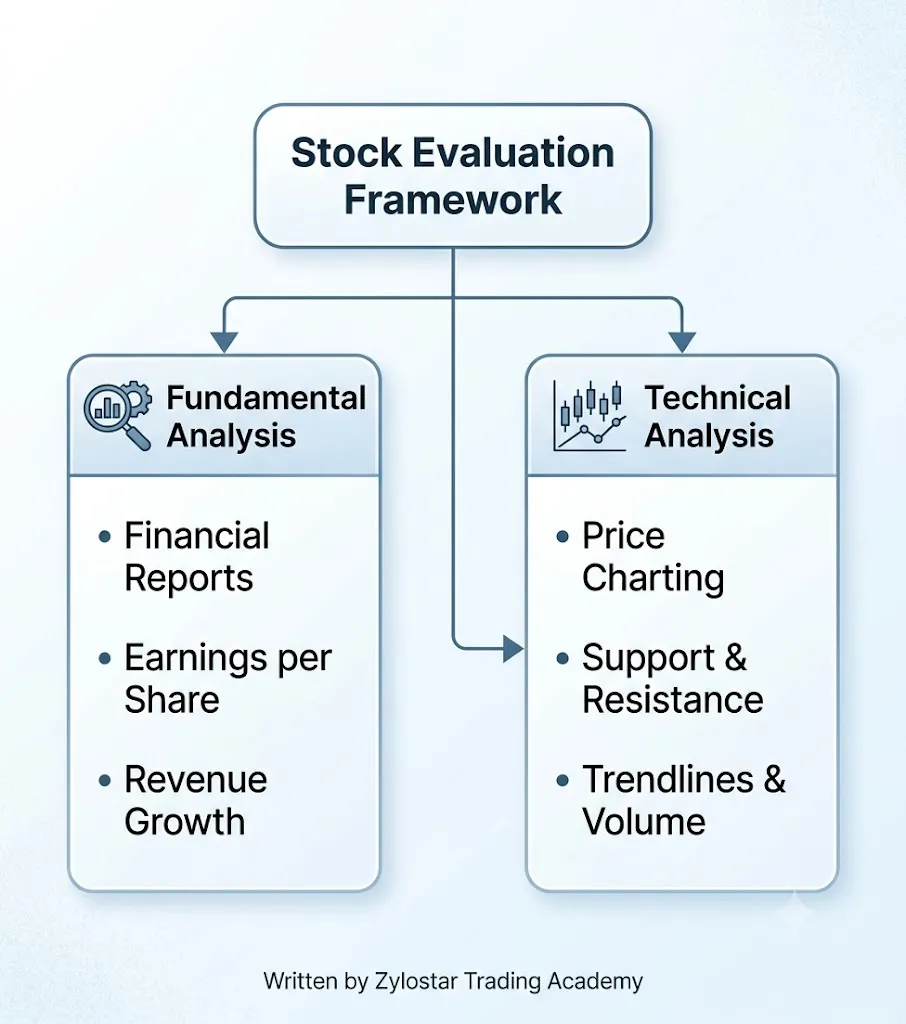
When conducting technical analysis vs fundamental analysis, remember:
- Fundamental Analysis: Focuses on company balance sheets, net income, dividend yields, and macroeconomic environment to determine intrinsic value.
- Technical Analysis: Examines historical price movements, candlestick patterns, volume, and support/resistance levels to time entries.
To learn how to combine chart reading with macro economics, check out our guide on Technical Analysis vs Fundamental Analysis: A Learning Guide.
Why Enrolling in Certified Trading Education Matters
Many new market participants experience unnecessary losses due to improper risk management, emotional trading, or a lack of structured education. Participating in certified stock market trading courses in Dubai equips students with practical experience through guided market analysis.
At Zylostar Trading Academy, our structured learning pathways focus on:
- Understanding market structure and institutional order flow
- Defining risk-to-reward ratios and managing drawdown
- Crafting a personalized trading plan tailored to local and global markets
To explore our full list of offline and online education modules, review our detailed guide on Certified Stock Market Trading Courses in Dubai.
Conclusion: Build Your Stock Trading Knowledge First
Starting your stock trading journey in the UAE requires systematic preparation, market knowledge, and discipline. By focusing on market fundamentals, mastering technical chart setups, and controlling risk on every trade, you can build consistent trading habits.
This Stock Market Trading Guide for Beginners in the UAE serves as your foundation. To continue building your trading skills, explore structured educational courses and apply your knowledge systematically.
Frequently Asked Questions (FAQ)
1. Can UAE residents trade international stocks like US equities?
Yes. Residents in the UAE can open accounts with international trading platforms or regional brokers licensed to provide access to major global markets like the NYSE and NASDAQ.
2. What is the minimum capital required to start stock trading in the UAE?
There is no fixed statutory minimum to start trading. Many online brokers allow you to start with modest deposits, though managing position sizing and broker fees requires appropriate account capitalization.
3. What is an NIN, and do I need one for global stock trading?
An NIN (National Investor Number) is required specifically for trading on local UAE stock exchanges like the DFM and ADX. It is not required if you are trading foreign equities through international brokerages.
4. How long does it take for a beginner to become profitable in stock trading?
Developing consistent profitability depends on individual learning dedication, risk discipline, and market experience. Most beginner traders spend several months mastering chart analysis and practice on demo accounts before trading live capital.
Author: ZYLOSTAR | Category: Stock | Published: | Views: 791